Description
Composition
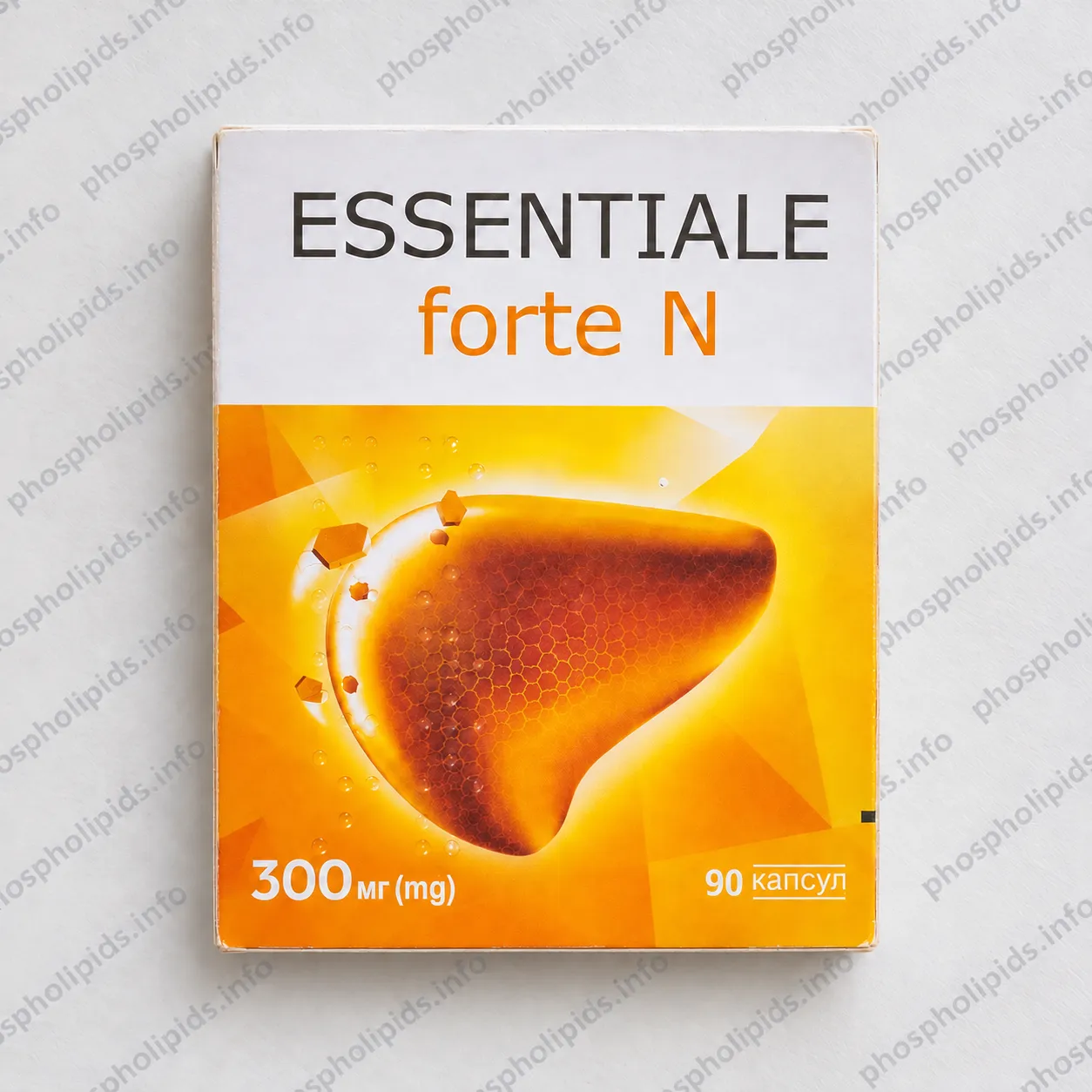
1 capsule contains essential phospholipids — EPL® substance (phospholipids from soybeans ((3-sn-phosphatidyl)choline), containing all-rac-α-tocopherol) — 300 mg.
Essential phospholipids — 300 mg.
Pharmacological Properties
Pharmacodynamics
In liver diseases, the membranes of hepatocytes and their organelles are invariably damaged, causing changes in the activity of membrane-bound enzymes and receptor systems, impairment of the cell’s metabolic function and a reduction in the rate of liver regeneration.
The phospholipids contained in Essentiale® Forte N are similar in chemical structure to endogenous phospholipids but greatly surpass them due to their high content of polyunsaturated (essential) fatty acids. These high-energy molecules are incorporated primarily into cell membrane structures and promote the repair of damaged liver tissue. Since the cis double bonds of these polyenoic acids prevent the parallel arrangement of the hydrocarbon chains of membrane phospholipids, the packing density of phospholipid structures decreases, resulting in an increased rate of substance influx and efflux. Membrane-bound enzymes form functional units that enhance their activity and ensure the physiological course of the principal metabolic processes. Phospholipids influence impaired lipid metabolism by regulating lipoprotein metabolism, as a result of which neutral fats and cholesterol are converted into forms suitable for transport, particularly through an increased ability of HDL to bind cholesterol, for further oxidation. When phospholipids are excreted through the biliary tract, the lithogenic index decreases and bile is stabilised.
Pharmacokinetics
When Essentiale® Forte N is taken orally, more than 90% of the medicine is absorbed in the small intestine. Most is broken down by phospholipase A into 1-acyl-lysophosphatidylcholine, 50% of which is immediately ethylated into polyunsaturated phosphatidylcholine during absorption in the small intestine. Polyunsaturated phosphatidylcholine enters the blood through the lymphatic vessels, predominantly in a complex with HDL, and is transported to the liver. The maximum phosphatidylcholine level in the blood is reached 6–24 hours after administration and averages 20%.
The half-life of the choline component is 66 hours, and that of saturated fatty acids is 32 hours. In pharmacokinetic studies in the human body, less than 5% of each of the administered isotopes ³H and ¹⁴C was excreted in the faeces.
Indications for Essentiale® Forte N
Non-alcoholic steatohepatitis, alcoholic steatohepatitis, acute and chronic hepatitis of various aetiologies, liver cirrhosis, preoperative and postoperative treatment for surgery on the liver and biliary tract, toxaemia of pregnancy, psoriasis, radiation syndrome.
Administration of Essentiale® Forte N
The initial dose of Essentiale® Forte N for adults and children aged 12 years and over is 2 capsules 3 times daily; the maintenance dose is 1 capsule 3 times daily. The capsules are taken with meals, without chewing, with a small amount of water. The total duration of treatment is at least 3 months.
Treatment of psoriasis begins with Essentiale® Forte N at a dose of 2 capsules 3 times daily for 2 weeks. This is followed by 10 intravenous injections of 5 ml of the medicine, together with PUVA therapy. After completion of the injection course, capsule administration is resumed and continued for 2 months.
Contraindications
Hypersensitivity to the components of the medicine.
Adverse Effects
Rarely, gastrointestinal disorders — diarrhoea — may occur when high doses of the medicine are used. In isolated cases, hypersensitivity reactions, rash, itching,
Special Warnings
Use During Pregnancy and Breastfeeding
Due to the limited amount of clinical study data on use in pregnant women, the medicine is not recommended during pregnancy or breastfeeding.
Children
Essentiale® Forte N is intended for use in children over 12 years of age with a body weight of ≥43 kg.
Effects on Reaction Speed When Driving or Operating Other Machinery
No effect has been identified.
Interactions
No interactions have been established.
Overdose
To date, no reports of overdose or intoxication during the use of Essentiale® Forte N have been received.
Storage Conditions
Store in a dry place at a temperature not exceeding 21 °C.
Information for healthcare professionals. Instructions for medical use of Essentiale® Forte N. Order of the Ministry of Health of Ukraine No. 124 dated 6 March 2015. Registration certificate of the Ministry of Health of Ukraine No. UA/8682/01/01.
Current Information
According to the ATC classification, Essentiale Forte N belongs to the group of medicines used for liver diseases and lipotropic substances. Its active substance is a complex of essential phospholipids (EPL). Essentiale Forte N is used in combination therapy for non-alcoholic fatty liver disease (NAFLD), alcoholic steatohepatitis, chronic hepatitis of various origins and liver cirrhosis. It may be used in preparation for surgery on the liver and biliary tract, during postoperative recovery, for toxaemia of pregnancy, psoriasis and in combination treatment regimens for radiation injuries. The EPL contained in the medicine help improve lipid and glycogen metabolism in the liver, inhibit lipid peroxidation, promote restoration of cell membranes and thus have hepatoprotective properties (Maev I.V. et al., 2020).
Essentiale Forte N: Physiological Basis for the Efficacy of Essential Phospholipids
The physiological role of phospholipids is broad and multifaceted. They are components of cell membranes and ensure their physiological fluidity. A normal human liver consists of approximately 300 billion hepatocytes, and the total surface area of all cellular and subcellular membranes is approximately 33,000 m². EPL are necessary for cellular differentiation, proliferation, regeneration and molecular transmembrane transport (phospholipids maintain and stimulate the activity of various membrane-bound proteins: enzymes (e.g. Na⁺/K⁺-ATPase, lipoprotein lipase, lecithin–cholesterol acyltransferase (LCAT), cytochrome oxidase) and receptors (e.g. insulin receptors)).
Phospholipids are precursors of prostaglandins and other eicosanoids, are necessary for ATP synthesis (acting as phosphate group donors), participate in fat emulsification in the gastrointestinal tract, are determinants of erythrocyte and platelet aggregation and influence immunological processes within the cell (Gundermann K.J. et al., 2011).
EPL help correct mitochondrial insufficiency and have antifibrotic properties. Experiments in rats and baboons showed that EPL (specifically, the dilinoleoylphosphatidylcholine they contain) are effective in blocking expression of the profibrogenic TGF-β1 gene and synthesis of alpha-1 procollagen mRNA, leading to reduced accumulation of type I collagen in hepatocytes and inhibition of liver fibrosis development (Weiskirchen R. et al., 2015). Animal studies have demonstrated the antilipidaemic and antiatherogenic efficacy of EPL (Leuschner L. et al., 1976).
Animal studies have confirmed the antioxidant, anti-inflammatory, antifibrotic, antiapoptotic and pro-regenerative properties of EPL in models of intoxication with chemicals or medicinal products (Gundermann K.J. et al., 2011).
Non-Alcoholic Fatty Liver Disease: Is It Time to Sound the Alarm?
NAFLD is the most common liver disease worldwide (Mavrogiannaki A.N., Migdalis I.N., 2013). NAFLD is characterised by excessive fat accumulation in the liver in people who do not drink alcohol or consume small amounts, i.e. ≤20 ml of alcohol daily for women and ≤30 ml for men. An additional diagnostic criterion is the absence of any other secondary causes of fatty infiltration of the liver, including, in particular, viral hepatitis C, glucocorticoid use, coeliac disease, Wilson’s disease, familial hypobetalipoproteinaemia and the detection of specific autoantibodies (autoimmune hepatitis), such as antinuclear antibodies. The criterion for diagnosing NAFLD is the detection of more than 5% of hepatocytes with macrovesicular steatosis in a liver biopsy or a liver fat content of 5.56% or more on proton magnetic resonance spectroscopy. NAFLD may vary in severity, from simple steatosis (fatty infiltration in more than 5% of hepatocytes) to the development of non-alcoholic steatohepatitis (NASH), with possible progression to fibrosis and cirrhosis, liver failure and even hepatocellular carcinoma. The disease is progressive: within 3 years of diagnosis, 25–39% of patients with NAFLD develop steatohepatitis and 10–25% develop cirrhosis (Kosmalsk M. et al., 2018).
This is an acquired liver disease in whose development metabolic stress plays an important role (Maev I.V. et al., 2019). Hereditary predisposition, various endocrine disorders and changes in insulin-like growth factor (IGF) expression play important roles in its development. In particular, increased IGF-2 activity and decreased IGF-1 activity are observed in the liver (Kosmalsk M. et al., 2018). Intestinal microflora is also considered to play an important role in the development of this condition. Disturbances of intestinal microbiocenosis contribute to insulin resistance, lead to increased production of reactive oxygen species in the intestine and oxidative stress, and increased production of free fatty acids in the intestine, consequently aggravating inflammation and leading to hepatocyte apoptosis (Varganova D.L. et al., 2019). At the same time, the pathogenesis of NAFLD remains incompletely understood. Meanwhile, the worldwide prevalence of NAFLD is increasing alarmingly, reaching 16.5% in people of normal body weight and up to 75% in people with obesity, among both adults and children (Maev I.V. et al., 2019). NAFLD is detected in more than 76% of patients with type 2 diabetes mellitus and 90% of people with severe obesity. Prevalence depends on ethnicity: NAFLD is detected more frequently in people of Hispanic and Mexican origin than in non-Hispanic White people and African Americans. Older people are at greater risk of developing this disease (Kosmalsk M. et al., 2018). The increasing prevalence is mainly explained by changes in dietary habits and a sedentary lifestyle (Dajani A., AbuHammour A., 2016).
NAFLD is often regarded as the hepatic manifestation of metabolic syndrome (MS). MS includes metabolic disorders such as hyperlipidaemia, glucose intolerance and obesity, as well as arterial hypertension. Obesity is currently considered the main factor in the development of this condition. Some researchers describe NAFLD as an independent risk factor for MS. NAFLD has been shown to increase the risk of type 2 diabetes mellitus (T2DM), atherogenic dyslipidaemia, cardiovascular disorders and exacerbation of existing cardiovascular diseases, as well as death from cardiovascular disease (Maev I.V. et al., 2019).
The gold standard for diagnosing NAFLD is biopsy; however, this expensive invasive method has not become widespread in clinical practice. Diagnosis is usually based on more accessible investigations, including ultrasound and measurement of plasma liver enzyme levels. Increased levels of aspartate aminotransferase (AST), alanine aminotransferase (ALT) and gamma-glutamyltransferase (GGT), as well as an increased AST/ALT ratio, are found. At the same time, normal plasma transaminase levels do not exclude steatosis (Maev I.V. et al., 2020).
At present, the primary recommendations for treating NAFLD are correction of obesity through a low-calorie diet and physical exercise, and control of hyperglycaemia through diet, insulin or oral hypoglycaemic agents. Lifestyle modification helps reduce the severity of steatosis and lower plasma liver enzyme (transaminase) levels. However, only a small proportion of patients adhere to recommended lifestyle changes, such as regular physical exercise and a balanced diet, over a prolonged period.
Essentiale Forte N: The Role of EPL in NAFLD Therapy
Pharmacotherapy aimed at reducing fat accumulation in hepatocytes and improving liver histology may improve the prognosis in NAFLD.
EPL are natural hepatoprotective agents consisting of a highly purified soybean extract containing 72–96% 3-sn-phosphatidylcholine. They are widely used in NAFLD therapy because they allow a reduction in the severity of steatosis as assessed by ultrasound, CT and liver biopsy. Given their antioxidant and antifibrotic properties and their ability to restore hepatocyte membranes, prescribing EPL for NAFLD is pathogenetically justified (Maev I.V. et al., 2019).
Studies have shown that Essentiale Forte N is effective not only in treating non-alcoholic steatohepatitis but also in combination therapy for viral hepatitis B, C and D and hepatic encephalopathy. EPL predominantly contain polyunsaturated phosphatidylcholine. They are necessary for building cell membranes (which consist of almost 65% phosphatidylcholine), promote regenerative processes and reduce aggregation of blood cells (platelets and erythrocytes). EPL enter the body with fatty, cholesterol-rich foods. However, a low-cholesterol diet is recommended in various diseases, including gastrointestinal disorders, excess body weight and diabetes mellitus. This results in EPL deficiency in the body, leading to impaired liver function; medicines containing EPL are recommended to correct this deficiency (Bunyatyan N.D. et al., 2019).
Another study of EPL efficacy included a total of 2,843 adult patients with newly diagnosed NAFLD who had at least one of 4 comorbidities: excess body weight/obesity, arterial hypertension, type 2 diabetes mellitus and hypercholesterolaemia. At least two metabolic comorbidities pathogenetically associated with NAFLD were present in 79.6% of participants, and excess body weight/obesity was recorded in 2,298 (80.8%) patients. Laboratory parameters, including ALT, AST, GGT, fasting plasma glucose and lipid profile, were measured before treatment and at 12 and 24 weeks after the start of therapy. A significant reduction in liver enzyme levels was observed after 24 weeks. Thus, including EPL in NAFLD treatment led to a sustained reduction in liver enzyme levels in patients with newly diagnosed NAFLD and concomitant metabolic diseases (Maev I.V. et al., 2020).
A study (n=324) evaluated the efficacy of EPL in treating NAFLD. Patients were divided into groups: without comorbidities (n=113), with concomitant type 2 diabetes mellitus (n=107) and with mixed hyperlipidaemia (n=104). All patients were advised to follow a standard diet and exercise. Participants took 1800 mg of EPL for 24 weeks, followed by 900 mg for 48 weeks. By the end of week 24, a significant reduction in symptom severity and plasma transaminase levels was observed (on average, ALT decreased by 50.8 IU and AST by 46.1 IU). Reduced severity of fatty infiltration was also observed on ultrasound. Dose reduction after 6 months led to relapse (appearance of clinical symptoms and increased transaminase levels) in 43.8% of patients without comorbidities and 63.2% of those with comorbidities. Based on these findings, continuous EPL administration is recommended to avoid disease relapse (Dajani A.I.M. et al., 2015).
Essentiale Forte N: EPL Efficacy in Clinical Studies
A review of clinical studies demonstrated both reduced severity of clinical symptoms and improvements in laboratory and histological parameters and in liver status assessed by ultrasound and CT with long-term EPL administration across a broad range of liver diseases. These included drug-induced liver injury, chronic viral hepatitis and hepatic coma. No adverse effects of EPL administration were recorded in the studies analysed (Gundermann K.J. et al., 2011).
A recent study (n=89) evaluated the efficacy of EPL in treating chronic hepatitis (CH). After 14 days of EPL therapy, both clinical improvement (reduced severity of pain, dyspeptic symptoms and asthenovegetative syndrome) and a reduction in cytolysis markers were observed (Kovaleva N.V., Ivanishkina E.V., 2015).
In a double-blind study, combination therapy with EPL and low-dose lovastatin resulted in a more effective reduction in LDL cholesterol than lovastatin plus placebo (Gundermann K.J. et al., 2011).
Essentiale Forte N: Conclusion
Essentiale Forte N is a medicine containing EPL as its active substance. Its hepatoprotective, antioxidant and antifibrotic properties have found broad application in treating degenerative and inflammatory liver diseases. EPL are building materials for cell membranes; therefore, this medicine may be used in combination therapy for radiation sickness and psoriasis, and to stimulate regenerative processes during liver surgery. EPL may be used to maintain liver function when a low-cholesterol diet is required (Bunyatyan N.D. et al., 2019).
Characteristics
Manufacturer: Opella Healthcare Group
ATC group: A05B A50** Various preparations
International name: PHOSPHOLIPIDES* (PHOSPHOLIPIDS*)
Pharmaceutical form: Capsules
Supply conditions: Available without a prescription
Strength: 300 mg
Number of units per pack: 90 capsules
Registration: UA/8682/01/01 dated 16 August 2018
Reviews
There are no reviews yet.