
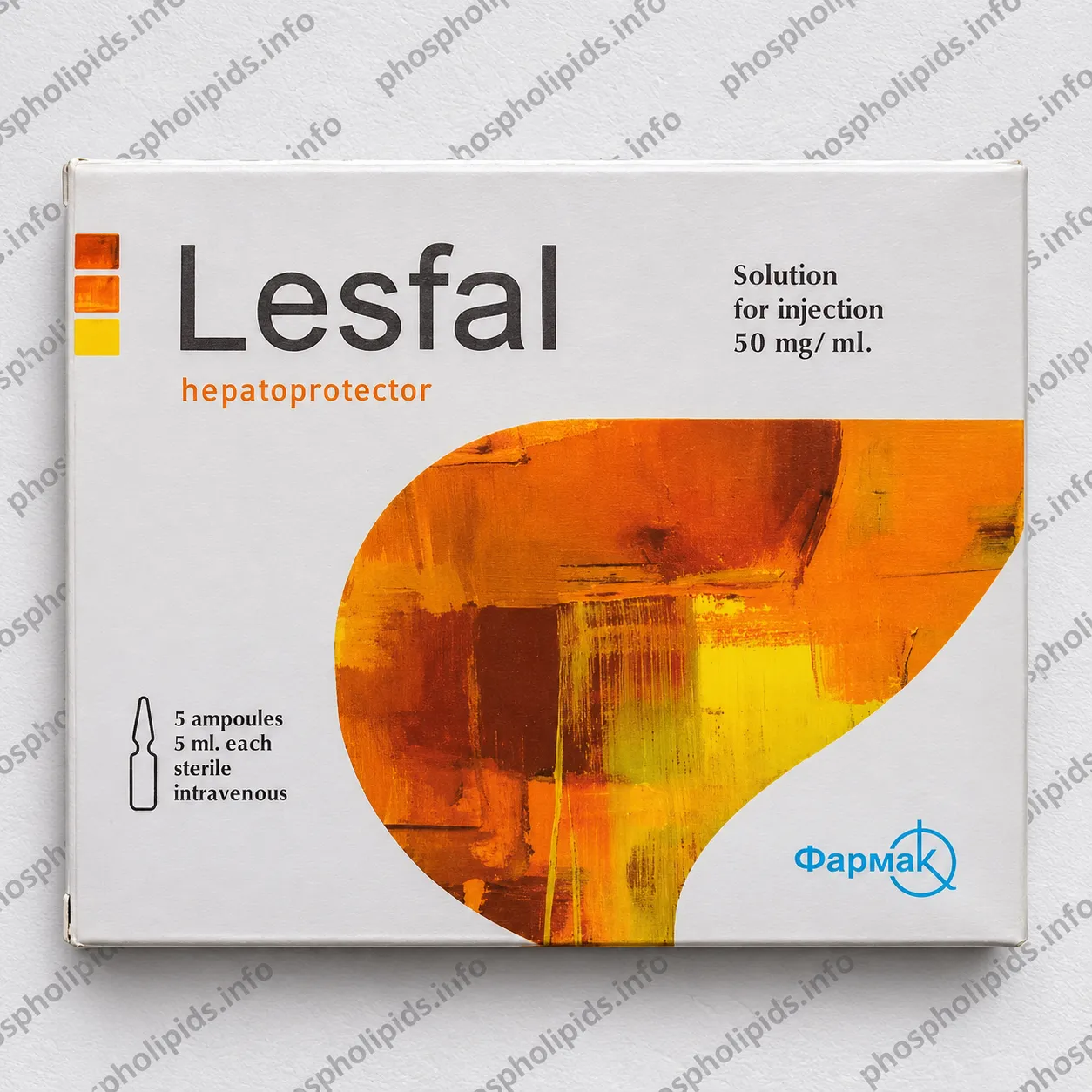
Description
Composition
Active substance: 1 ml of solution contains 50 mg of phosphatidylcholine from soybeans;
Excipients: benzyl alcohol, deoxycholic acid, sodium chloride, sodium hydroxide, riboflavin (E101), water for injections.
Pharmaceutical Form
Solution for injection.
Basic physicochemical properties: a clear yellow solution.
Pharmacotherapeutic Group
Hepatotropic preparations. ATC code A05B A.
Pharmacological Properties
Pharmacodynamics
In liver diseases, the membranes of hepatocytes and their organelles are invariably damaged, which may lead to changes in the activity of membrane-bound enzymes and receptor systems, impairment of the cell’s metabolic function and a reduction in the rate of liver regeneration.
The phospholipids contained in Lesfal are similar in chemical structure to endogenous phospholipids but greatly surpass them due to their high content of polyunsaturated (essential) fatty acids. These high-energy molecules are incorporated primarily into cell membrane structures and facilitate the repair of damaged liver tissue. Since the cis double bonds of these polyenoic acids prevent the parallel arrangement of the hydrocarbon chains of membrane phospholipids, the packing density of phospholipid structures decreases, resulting in an increased rate of substance influx and efflux. Membrane-bound enzymes form functional units that may enhance their activity and ensure the physiological course of the principal metabolic processes. Phospholipids influence impaired lipid metabolism by regulating lipoprotein metabolism, as a result of which neutral fats and cholesterol are converted into forms suitable for transport, particularly through an increased ability of high-density lipoproteins (HDL) to bind cholesterol, and are directed towards further oxidation. When phospholipids are excreted through the biliary tract, the lithogenic index decreases and bile is stabilised.
Pharmacokinetics
When taken orally, more than 90% of the medicine is absorbed in the small intestine. Most is broken down by phospholipase A into 1-acyl-lysophosphatidylcholine, 50% of which immediately undergoes reacetylation into polyunsaturated phosphatidylcholine during absorption in the small intestine. Polyunsaturated phosphatidylcholine enters the blood via the lymph and is then transported to the liver, predominantly in a complex with HDL. The maximum phosphatidylcholine content in the blood 6–24 hours after oral administration averages 20%.
The elimination half-life of the choline component is 66 hours, and that of saturated fatty acids is 32 hours.
In studies of kinetics in the human body, less than 5% of each of the administered isotopes ³H and ¹⁴C was excreted in the faeces.
Indications
Non-alcoholic steatohepatitis, alcoholic steatohepatitis, acute and chronic hepatitis of various aetiologies, liver cirrhosis, preoperative and postoperative treatment for surgery on the liver and biliary tract, toxaemia of pregnancy, psoriasis, radiation syndrome.
Contraindications
Hypersensitivity to any of the components of the medicine.
Lesfal should not be prescribed to newborns or premature infants because the medicine contains benzyl alcohol.
Interactions with Other Medicinal Products and Other Forms of Interaction
Electrolyte solutions must not be used to dilute the medicine.
Special Precautions for Use
When diluting Lesfal to prepare infusion solutions (if the patient’s own blood cannot be used), electrolyte-free solutions should be used, namely: 5% or 10% glucose solution (in a 1:1 ratio), or 5% xylitol solution.
Use only a clear solution.
The medicine is incompatible with electrolyte solutions (physiological sodium chloride solution, Ringer’s solution, etc.).
Do not mix with other medicinal products in the same syringe.
Warning: the solution contains 5.02 mg/ml of alcohol.
1 ml of Lesfal contains 0.1 mmol of sodium. At a dose of 10 ml, the sodium content is 1.0 mmol (25.8 mg), which should be taken into account by patients on a controlled-sodium diet.
For intravenous use only. The medicine should be administered slowly.
Lesfal solution must not be injected into muscles (intramuscularly), as this may cause local irritation.
Use During Pregnancy or Breastfeeding
Due to the limited amount of clinical study data on use in pregnant women and the presence of benzyl alcohol, which can cross the placental barrier, the use of Lesfal is not recommended during pregnancy or breastfeeding.
Effects on Reaction Speed When Driving or Operating Other Machinery
None identified.
Method of Administration and Dosage
Adults and children aged 12 years and over should be given 5–10 ml daily by slow intravenous administration, or 10–20 ml daily in severe cases. 10 ml of the medicine may be administered at one time. If the medicine is administered diluted, it is recommended to use the patient’s own blood and dilute the medicine in a 1:1 ratio. Intravenous infusion is usually used for up to 10 days.
It is recommended to support (supplement) parenteral therapy with oral administration of medicines containing phosphatidylcholine as early as possible.
The total course of treatment is 3–6 months.
Treatment of psoriasis begins with oral administration of phosphatidylcholine for 2 weeks. After this, 10 intravenous injections of 5 ml are recommended, with concomitant PUVA therapy.
After completion of the injection course, oral administration of phosphatidylcholine should be resumed and the medicine continued for 2 months.
Children
Lesfal solution for intravenous injection must not be prescribed to newborns or premature infants because the medicine contains benzyl alcohol. Administration of medicines containing benzyl alcohol to infants and premature babies has been associated with the development of fatal respiratory distress syndrome (“gasping syndrome”, the symptoms of which are the sudden onset of respiratory distress, arterial hypotension, bradycardia and cardiovascular collapse).
The medicine is intended for use in children aged 12 years and over with an approximate body weight of 43 kg (see the section “Method of Administration and Dosage”).
Overdose
No reports of overdose have been recorded.
Adverse Reactions
In individual cases, gastrointestinal disorders (diarrhoea) may occur when higher doses of Lesfal are used.
In isolated cases, hypersensitivity reactions, rash, itching, urticaria and reactions at the administration site may occur.
Shelf Life
2 years.
Do not use the medicine after the expiry date stated on the packaging.
Storage Conditions
Store protected from light at a temperature between 2 °C and 8 °C.
Keep out of the reach of children.
Packaging
5 ml per ampoule. 5 or 10 ampoules per carton.
5 ampoules per blister pack. 1 or 2 blister packs per carton.
Manufacturer
PJSC “Farmak”.
Manufacturer’s Location and Address of the Manufacturing Site
Ukraine, 04080, Kyiv, 74 Frunze Street.
Characteristics
Manufacturer: Farmak
ATC group: A05B A50** Various preparations
International name: PHOSPHOLIPIDES* (PHOSPHOLIPIDS*)
Pharmaceutical form: Solution for injection
Supply conditions: Prescription only
Strength: 50 mg/ml
Number of units per pack: 5 units
Registration: UA/12317/01/01 dated 12 June 2017
Dr. Gordana –
Probably most appropriate substitute to essentiale from Sanofi. analysis showed 87% of efficiency comparing to Ess.